Learning Activity 2:
Planned or Managed Change and Selected Theories
"There are two primary choices in life: to accept conditions as they exist, or accept the responsibility for changing them."" - Dr. Denis Waitley
"Never doubt that a small group of thoughtful citizens can change the world. Indeed, it is the only thing that ever has."" - Dr. Margaret Mead
Overview
 Societal change is often the result of careful planning and skilled management. Theory developed on this kind of change is often categorized as planned or managed change theory. Nurses can become visible and efficient agents for planned/managed change, both in health care and society at large. Several viable theories and change tools exist to help guide this process.
In this learning activity we will look at several powerful models that have developed from some of these change theories. These include the:
- Grandfolkie Managed Change Theory,
- Appreciative Inquiry Theory,
- Stages of Change Theory,
- Health Belief Theory,
- Theory of Reasoned Action,
- Change Equation Theory,
- Gestalt Paradoxical Theory of Change.
All of these theories serve as useful guides and tools for planning change with individual clients, groups, communities, and organizations.
"Indeed, these are changing times in health care, but they are also exciting ones if nursing chooses to be proactive in its response to these changes at the individual and organizational levels. Creativity will be needed to provide new solutions to problems. Let us look at these changes as opportunities to influence decisions in our organizations. Will you choose to be reactive or proactive?"" (Simon, 1999, p. 1).
Grandfolkie Managed Change Theory
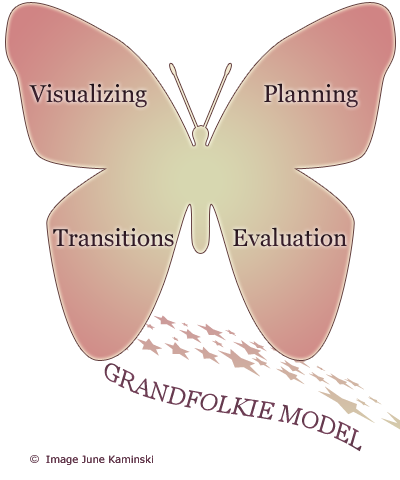
This theory developed by Phyllis and Walter Robbins, offers an empowered guide for managed change, intended to help people adapt to the perpetual change of our current world. The premise is that effective planned or managed change is a learned behaviour - thus, they offer a roadmap through change that spans from Visualizing the change to Planning, Transitions, and Evaluation. Each of these four steps includes several processes that the person moves through until they eventually achieve effective managed change. Every step is deliberate yet well managed with the intention of moving through change in an insightful and controlled way. The goal is to see the change as a 'journey' that can be navigated skillfully without chaos, anxiety, or feeling overwhelmed.
4-D Appreciative Inquiry Theory
Appreciative Inquiry
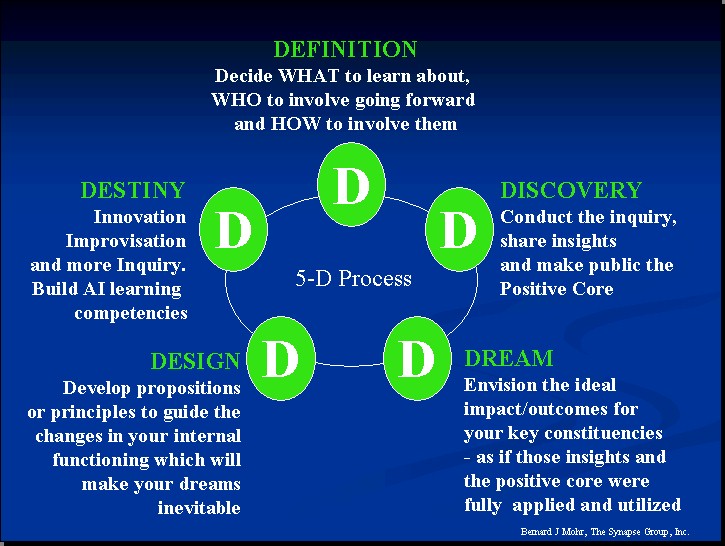
Appreciative Inquiry (AI) is a capacity building approach that selectively seeks to locate, highlight, and illuminate the life-giving forces within an organization or community. AI seeks out the best of “what is” to help ignite the collective imagination of “what might be”. The aim is to generate new knowledge that expands the “realm of the possible” and helps people envision a collectively desired future and to carry forth that vision in ways which successfully translates images of possibility into reality, and belief into practice. AI is not a methodology. It is a philosophy, an orientation to change, and a way of seeing and being in the world!
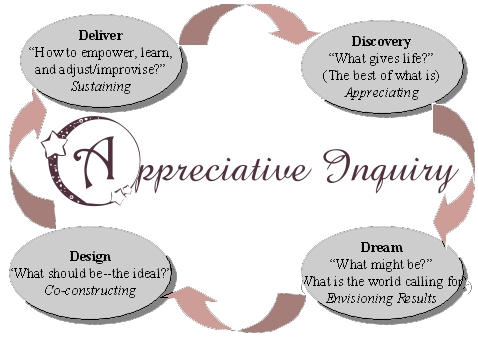
The AI 4-D Theory entails four stages of change activity:
- Discovers what gives life to an organization; what is happening when the organization is at its best;
- Dreams about what might be; what the world is calling the organization to be;
- Designs ways to create the ideal as articulated by the whole organization; and,
- Delivers through an on-going and iterative processes. This is not a static solution but rather a dynamic process of continuous change.
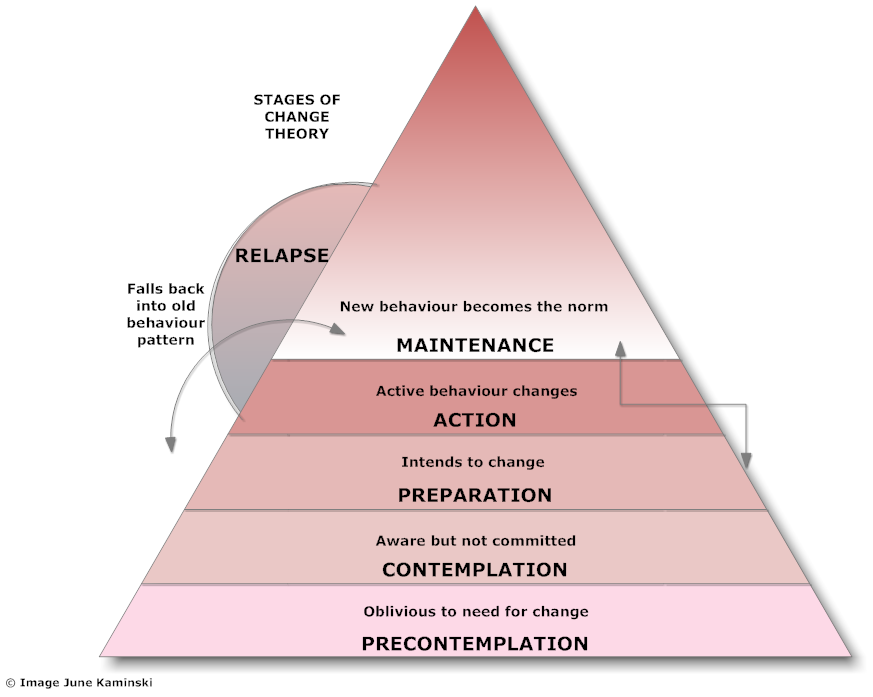
Stages of Change Theory
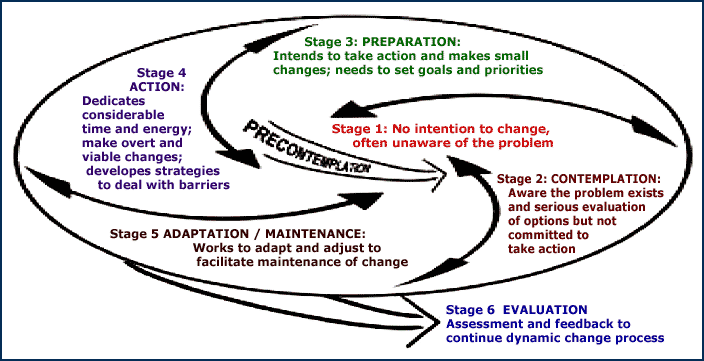
The Stages of Change theory was first developed by James Prochaska and Carlo DiClemente at the University of Rhode Island in the 1970s (the height of the behaviourist era) to model how people broke free from cigarette smoking addiction. Since then, the theory has been applied to a wide range of behaviourial changes such as other addictions, weight loss, and 'bad' habits in general. The premise of this theory is that change does not happen over night, and that people often relapse or fall back into their old patterns of behaviour before successfully reaching the maintenance stage where the new behaviour becomes the norm. The theory also acknowledges that people must ultimately change themselves, it must be their own idea to succeed.
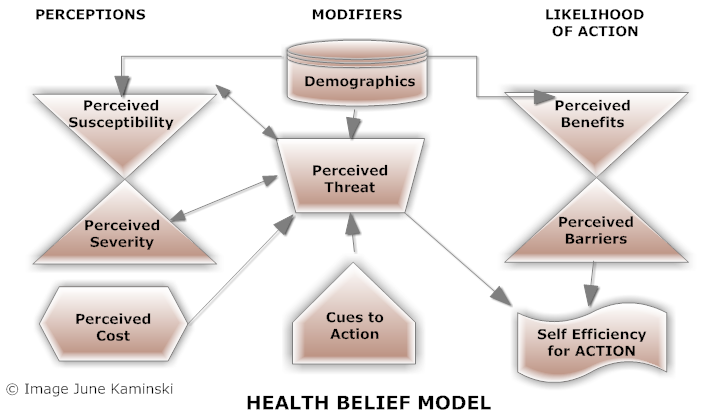
Health Belief Model
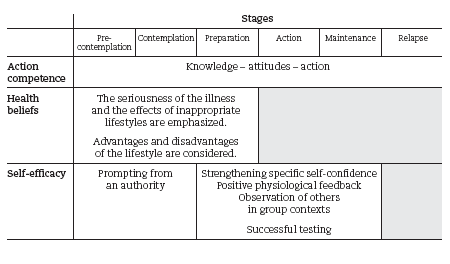
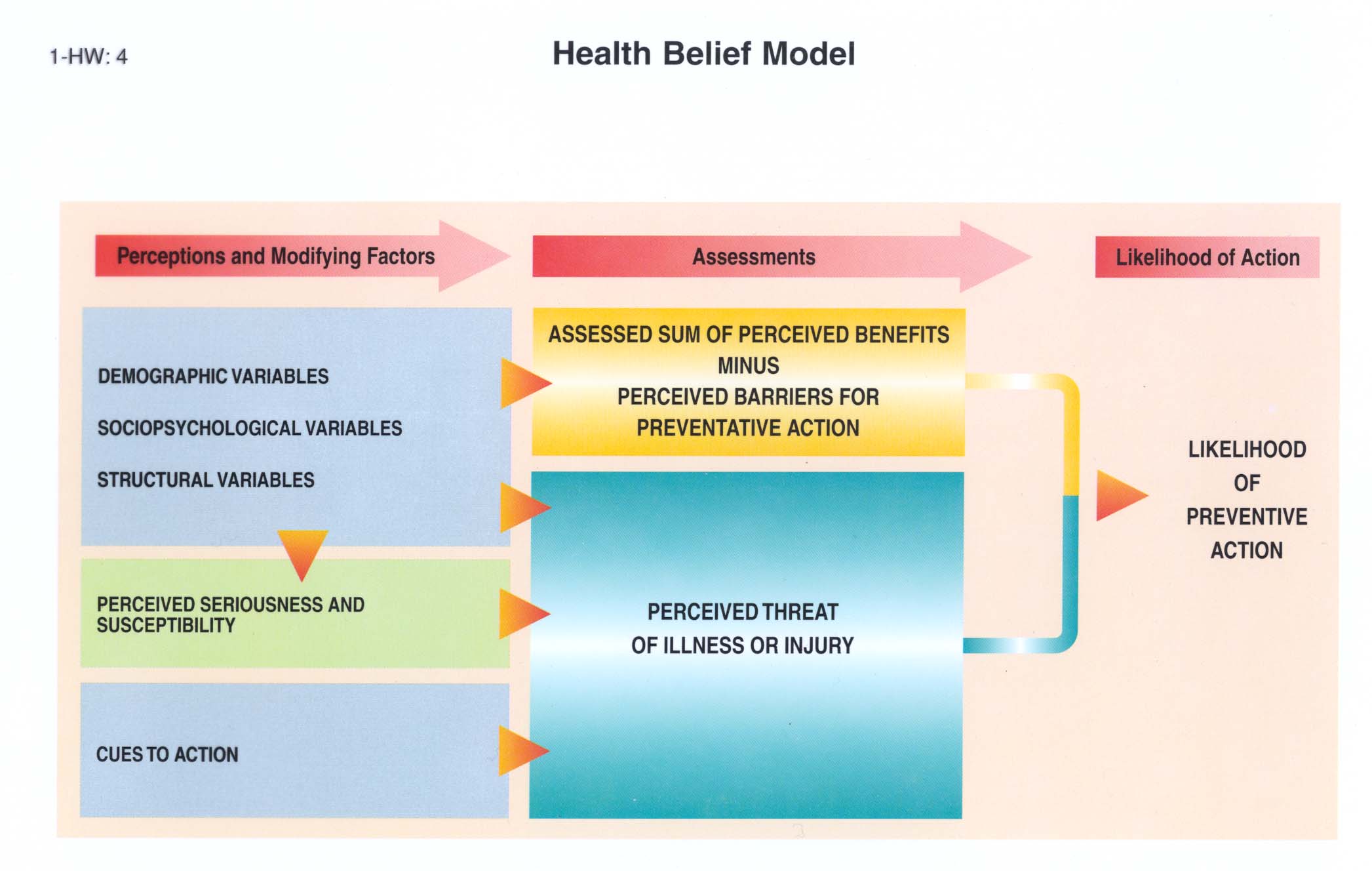
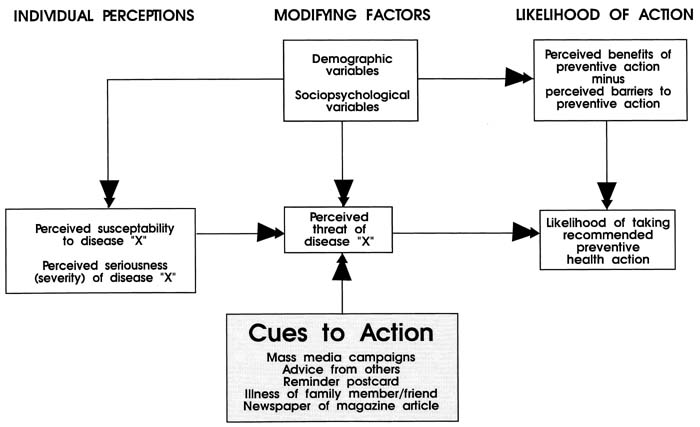
This behavioural model, first introduced by Irwin Rosenstock in the mid 1960s and revised right into the late 1980s, predicts likely health behaviours in the context of personal perceptions, modifying factors, and likelihood for action. Work on the model began in the 1950s by Rosenstock for the US Public Health Service to indicate people's behaviours in relation to seeking xray examination for tuberculosis. The premise that a person's view of the perceived threat of a disease is influenced by their perceived susceptibility to the disease, and how they perceive the severity or seriousness of the disease. Cues for action from the media, health professionals, family, etc. also influence the perceived threat, as do the person's demographic status. As well, perceived benefits of seeking treatment and perceived barriers to the treatment influence their self efficiency for taking action.
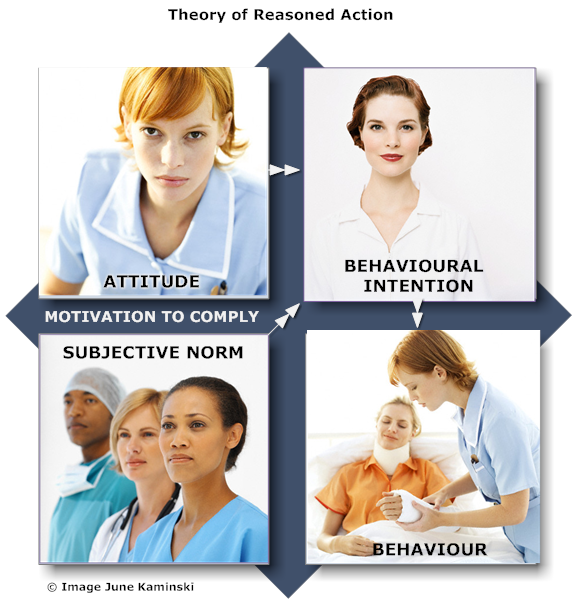
Theory of Reasoned Action
This theory was published by Martin Fishbein and Icek Ahzen in the mid 1970s to provide a social psychological theory that focused strongly on attitude and behaviour in the context of change. The gist of the model is that a person's behaviour reflects their attitude about the behaviour and their notion of what people will think of them if they perform the behaviour (subjective norm). Attitude reflects the person's various beliefs about a behaviour and how much significance or weight the person gives to each belief. For instance, a person might have very different beliefs about a certain behaviour, such as eating wholesome foods is good for me, but also eating wholesome foods is expensive and beyond my grocery budget. Attitude plus subjective norm forms the person's behavioural intention. The importance of attitude versus subjective norm varies from person to person. Some value their own attitude (beliefs) over the opinions of others (subjective norm), while others put great stock in what others think and say.
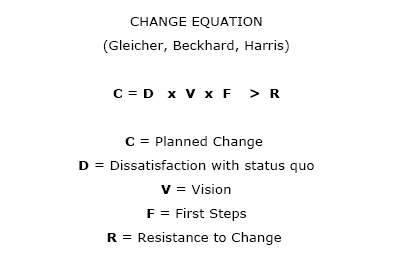
Change Equation Theory
It is important to note that the three components must all be present to overcome the resistance to change in an organization:
- Dissatisfaction with the present situation,
- a Vision of what is possible in the future,
- and achievable First steps towards reaching this vision.
If any of the three is zero or near zero, the product will also be zero or near zero and the Resistance to change will dominate.
Gestalt Paradoxical Theory of Change
 This theory, developed by Arnold Bessier is based on the work of Frederick Perls, the 'father' of Gestalt theory. Bessier summed up the theory by explaining, “that change occurs when one becomes what he is, not when he tries to become what he is not. Change does not take place through a coercive attempt by the individual or by another person to change him, but it does take place if one takes the time and effort to be what he is -- to be fully invested in his current positions. By rejecting the role of change agent, we make meaningful and orderly change possible.” (1970, p. 1).
Ends In View
This learning activity is intended to provide learners with the opportunity to:1. Apply change theories and methods to nursing issues and situations.
2. Examine how individual assumptions, perceptions, behaviour patterns, and supporting structures can act as barriers to change in individuals, organizations, and society at large.
3. Comprehend the complexity of change within organizational, political and national cultures and systems.
4. Analyze the dynamics of planned and/or managed change at personal, group, organizational, and societal levels.
In Practice
- In small groups, draw a model to illustrate the Paradoxical Theory of Change described by Harris.
- Participate in class discussion related to the change theories presented in the preparatory readings. How can these models be useful to nurse leaders and change agents?
- 1.How do the Empowering (Grandfolkie readings) and Behavior Change (FHI reading) Theories differ from the Organizational and/or Societal Change (Seel, Harris, Kaminski readings) Theories presented? Could they be interchangeable at the personal, group, and organizational - societal levels?
- Appreciative Inquiry is one of the most contemporary of the theories studied in this learning activity. What unique ideas, premises, philosophy does this approach bring to nursing and society at large? Does this philosophy suit the profession of nursing? Does it seem realistic?
- In small groups create a brief case scenario related to nurses influencing client or societal change, applying one of the models studied. Present your case to the class.
In Reflection
- .Consider which of the theories studied would be useful in your change project work for N4141.
- How could these theories be useful to you as an individual for making changes in your own life?
- Which theory will you use for your change assignments?
References
Beckhard, R. & Harris, R. (1987). Organizational transitions. 2nd ed. Reading, MA: Addison-Wesley.Beisser, A. (1970). Paradoxical Theory of Change. www.gestalt.org/arnie.htm
Cooperrider, D. & Whitney, D. (2002) A positive revolution in change: Appreciative Inquiry. Euclid, OH: Lakeshore Publishers.
http://appreciativeinquiry.cwru.edu/uploads/whatisai.pdf
FHI. (2002). Behavior Change – A Summary of Four Major Theories. Family Health International.
Simon, J. M. (1999). Change: An opportunity for creativity. Nursing Diagnosis, Apr – Jun.
findarticles.com/p/articles/mi_qa3836/is_199904/ai_n8830905/print
 IN PREPARATION: